Wednesday, April 23, 2008

They Promised Us Convergence, part 4


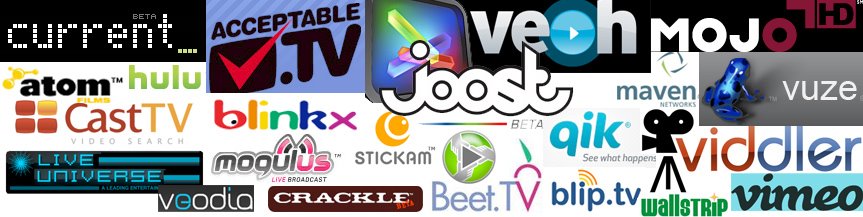
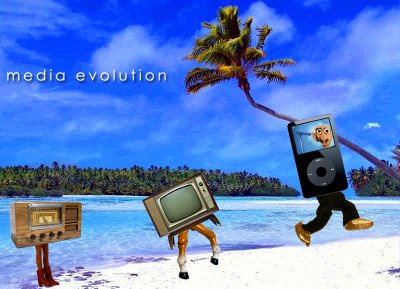
The great plodding march toward complete convergence continues. TV and movies are merging with the digital world. This series on my blog tracks many of the companies, creators and video sites that have joined this quest for convergence. Below are links and quotes about many of the sites I didn't cover in parts 1, 2 and 3.
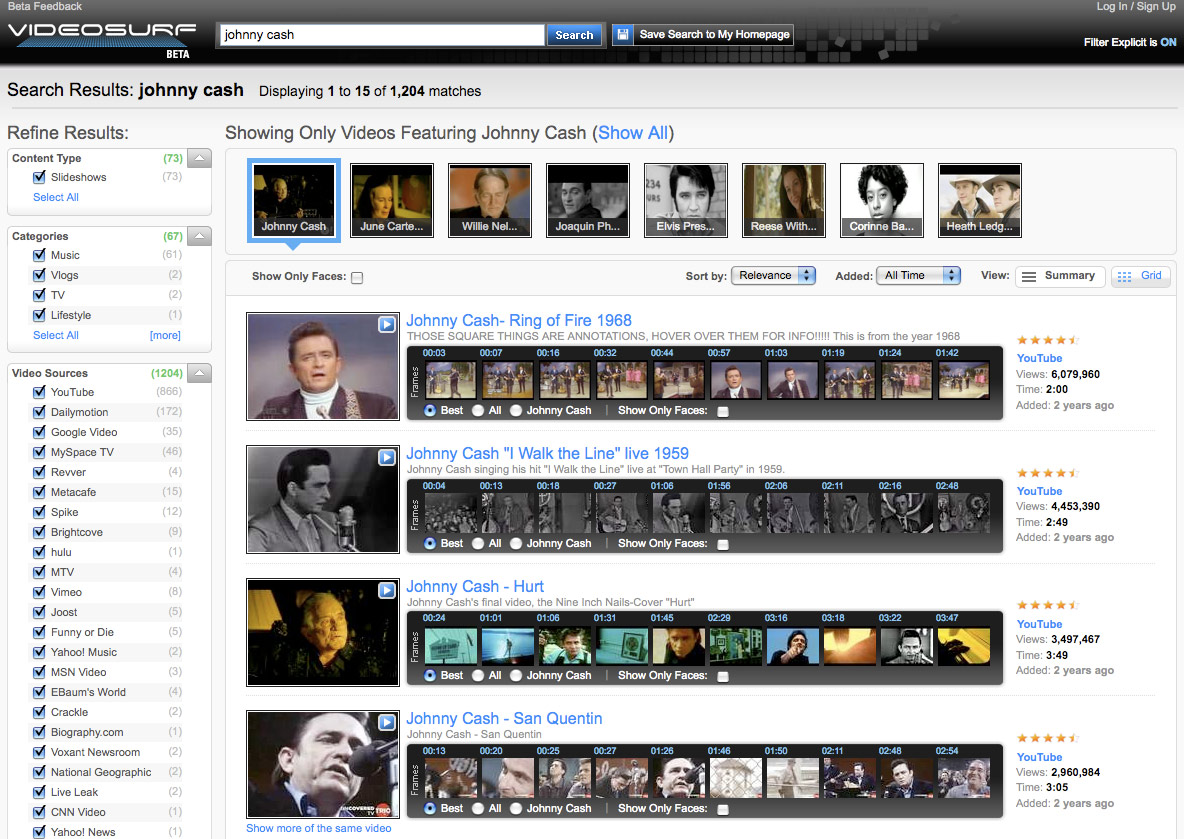
The goal of CastTV is "to index every video on the web (from YouTube to iTunes, and everything in between) and to help users find videos that matter to them."

"Viddler is a fresh, creative web application that lets you upload, enhance, and share digital video quickly and easily inside your web browser. Sharing your story. Making search results relevant. Bringing users together."

"LiveVideo is where you want to be to find original and exclusive content, weekly video contests, and great videos. Essentially, LiveVideo is your ultimate video destination on the web. We are a customizable video streaming community that allows users to watch, upload, search and share videos, allowing you to have a completely interactive video sharing experience!"

Stickam is "driving the next wave of business communications with rich media meetings that liberate users from time and geographical constraints." They provide "Web communication services... designed for the delivery of multimedia Web communications."

Qik lets you "stream live video fast to the world. Right from your phone."

MoveNetworks is calling themselves TV 2.0.

"WorldTV is an entirely new concept in the world of web video. More than 10 years in the planning, it realizes a long term vision to empower anyone, anywhere to become their own media mogul, and to create their own fabulous TV Channel."

Adobe Media Playerlaunched a media player that works great for finding, cataloging and watching your videos.

Also see my recent post about the DIY Video Summit.

Remember that the deadline for the mandatory shift to digital television draws ever closer. See my recent post T-Commerce, Digital TV and the Digitization of Content.

The set top box market continues to take in new players. "VUDU is the revolutionary new movie on-demand service that provides instant access to more than 6,000 movies and TV shows, with hundreds of titles in high-definition. Whether you're in the mood for a top Hollywood new release or an art-house classic, VUDU lets you rent or purchase and starts playing faster than you can grab the popcorn." FOXTEL has a pretty great box. And this month also saw a widly publicised rumor that Blockbuster Video is about to announce a set top box of their own and this rumor appears to be true.

Maven is "the power of internet TV" and was bought by Yahoo for $160M. "Introducing the first and only complete online video advertising solution to dramatically increase video advertising inventory and revenue via new ad formats, an intelligent and dynamic video ad insertion engine, and sophisticated video ad inventory management tools."

Live Universe, the latest venture from MySpace founder Brad Greenspan, bought Revver, in February 2008. LiveVideo.com is another project by Live Universe.

BuddyTV is "original and fresh coverage on TV Shows, TV News, TV Spoilers, Live TV Commentary, TV listings, Forums, and Community."

"MeeVee is the first destination to bring together traditional TV listings and online video from hundreds of sources in one place. Using innovative new technologies, MeeVee has changed the way viewers find TV programming and online video by enabling them to personalize their guides to surface new programming choices based on individual interests."

Beet TV continues to crank out great video coverage of many of these topics.

Mogulus is "giving users the power to create live, original television programming, all done on their own global broadcasting channel."

PermissionTV will give you the tools to monetize your video assets.

ViralVideos displays "the web's most shared viral videos."

YouTorrent, is a meta search engine that finds you bit torrents.

Stay tuned for more in this ongoing series. Check out the previous posts:
They Promised Us Convergence, part 3
They Promised Us Convergence, part 2
They Promised Us Convergence, part 1


Labels: , , , , , , ,

Thursday, April 17, 2008

Wired Science: Free Video for Geeks


"Take the DNA of WIRED Magazine, the first word on how science and technology are changing the world. Add the giant-robot might of PBS. Result: WIRED Science, a new weekly series that brings the magazine’s award-winning journalism, groundbreaking design and irreverent attitude to public television."

Labels: , , , ,

Wednesday, April 16, 2008

Aggregators Pointing to Aggregators: Is Real Content Dead?


The last few years have seen a tremendous rise in aggregators, sites that link to top news and entertainment stories located on other sites. Numerous cries can be heard that true journalism and thoughtful commentary are dead because sites are linking to anything they can find, from blogs to wikis to amateur movies. Does this signal the end of content creation as we know it? Will we end up in a world where links only lead to more links, endlessly in circles, till the end of time?

In the video above Guy Kawasaki talks about his recent aggregation venture, AllTop, with Drue Kataoka of Valley Zen. He is experiencing great success automatically gathering and posting news based on topics such as celebrities, science and politics.

Of course, one of the grand-daddies of this approach is Thomas Marban and his outrageously popular PopURLs site. One page. A bazillion links.

The examples of this phenomenon are extremely numerous: Google News, Topix, Newser, TechMeme, Digg, BuzzFeed, or any of the hundreds of other aggregators.

AdAge has a great recent article about these subjects called It's Web 3.0, and Someone Else's Content Is King (Without Original Reporting, How Long Can the Aggregation Party Last?) They cover the doom and gloom side of the story well, but also point to the encouraging opportunities for aggregator sites and content creators. They also pull some great tidbits from The Pew Center's annual report on American journalism, The State of the News Media 2008. Both definitely worth the read.

I actually think all this is great news for modern digital content creators. As traditional publishing moves toward the digital platform, the market fragments. This separates the creators from the designers from the marketers from the distributors. Content developers are now on their own and this makes the content more valuable. When the giant content factories begin to focus on promotion and delivery, the individual writers and creators can shine. And they can charge top dollar for their product, whose value increases.

Labels: , , , , ,

Tuesday, April 15, 2008

Ray Kurzweil: Outrageous Inventor, Entrepreneur, Thinker and Doer


Filmed in 2005 "Prolific inventor and outrageous visionary Ray Kurzweil explains in abundant, grounded detail why -- by the 2020s -- we will have reverse-engineered the human brain, and nanobots will be operating your consciousness. Kurzweil draws on years of research to show the speed at which technology is evolving, and projects forward into an almost unthinkable future to outline the ways we'll use technology to augment our own capabilities, forever blurring the lines between human and machine." From TED.com.

On the list of contemporary creative thinkers I'd like to eat a sandwich with, Kurzweil is near the top. I appreciate and respect a person who can simultaneously dream fantastical notions and also perform practical technical feats. He not only thinks, he does. He thinks about the power of cell phone cameras years before the technology is mature. Then he does a project and works with the American Foundation for the Blind to create a working product that will speak the text of photos taken with a modern cell phone so that blind people can read pasta box labels and street signs and love letters.

Check out Kurzweil Technologies to learn about his numerous successful business ventures. He's been building and selling companies since he was a teenager. He's started music product companies, the FatKat Artificial Intelligence investment tool and educational technology companies.

I've always been curious about his thoughts on the coming technological singularity. This is a point in the (near?) future where technology will be accelerating at such a super fast rate that culture will reach an almost magical point. Our tools and combined intelligence will make almost anything possible, including (near) immortality.

A recent Wired article has a current look at the modern Kurzweil. He is making sure that, when the singularity arrives, he's good and healthy. He rides his bike, he's lost 30 pounds, he takes dozens of vitamins and supplements every day and he's on a strict diet. (Futurist Ray Kurzweil Pulls Out All the Stops (and Pills) to Live to Witness the Singularity)

Wikipedia says, "Raymond Kurzweil (pronounced /kɚzwaɪl/) (born February 12, 1948) is an inventor and futurist. He has been a pioneer in the fields of optical character recognition (OCR), text-to-speech synthesis, speech recognition technology, and electronic keyboard instruments. He is the author of several books on health, artificial intelligence, transhumanism, the technological singularity, and futurism."

See some of his books on Amazon.
Fantastic Voyage: Live Long Enough to Live Forever
The Age of Spiritual Machines
The Singularity Is Near: When Humans Transcend Biology

Labels: , , , , , , ,

Thursday, April 10, 2008

Adobe Media Player for Internet TV Content


Adobe is now in competition with iTunes, Windows Media Player and Real Player. Their new Adobe Media Player is a great digital media content player that helps you organize your favorites and find great video and audio.

Adobe has also teamed up with a bunch of participating content producers and suppliers such as CBS, Comedy Central, BlipTV, MTV and Universal.

Adobe has a great history of making universal, cross-platform apps that quickly become the standard. This Media Player has a chance to become the standard tool that allows digital content consumers to aggregate and control the incredible amount of audio and video that is sprouting anew every day on the web. Check out my previous three articles on the convergence of TV and the web.

"Adobe Media Player software provides control and flexibility to view what you want, when you want — whether online or offline. You can queue up and download your favorite Internet TV content, track and download new episodes automatically, and manage your personal video library for viewing at your convenience."

Labels: , , , , , , ,

Friday, April 4, 2008

DIY Video in the Age of Digital Media


Howard Rheingold has been one pixel ahead of most people for decades now. His writings and thoughts about new media, grassroots communications and virtual communities must be digested by any serious student of the digital age. Howard and I worked together at Whole Earth Catalog in the early 90s. He's the guy who came running into the office waving a floppy disc above his head screaming, "You've gotta see this." It was the first Mosaic browser and it blew our minds.

Check out the video above from the 24-7 DIY Video Summit. You'll see an intro by Howard and some video of Henry Jenkins, author of Convergence Culture: Where Old and New Media Collide. Thanks to Ulrike Reinhard for the video.

The DIY Video Summit is described below in their own words:

"We are in the early stages of a fundamental transformation in how we create, share and view dynamic visual media. This transformation is enabling a new media ecology that can support widespread amateur video creation, and peer-to-peer and many-to-many distribution to audiences both large and small. Although it is clear that there is tremendous demand for user-generated and bottom-up forms of digital video, it remains unclear how best to support these creative projects, what the implications are for artistic practice and how to build bridges between old and new media."

Labels: , , , , , , , , , , ,