Wednesday, April 23, 2008

They Promised Us Convergence, part 4


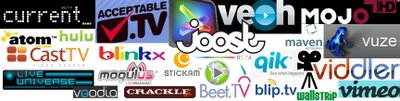
The great plodding march toward complete convergence continues. TV and movies are merging with the digital world. This series on my blog tracks many of the companies, creators and video sites that have joined this quest for convergence. Below are links and quotes about many of the sites I didn't cover in parts 1, 2 and 3.

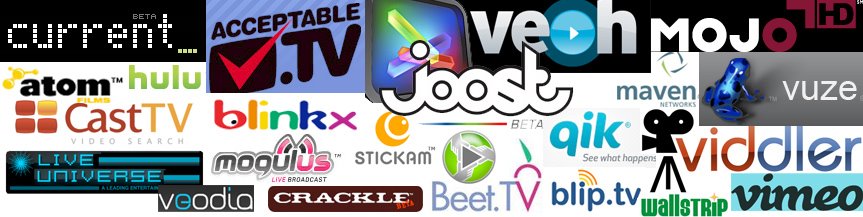
The goal of CastTV is "to index every video on the web (from YouTube to iTunes, and everything in between) and to help users find videos that matter to them."

"Viddler is a fresh, creative web application that lets you upload, enhance, and share digital video quickly and easily inside your web browser. Sharing your story. Making search results relevant. Bringing users together."

"LiveVideo is where you want to be to find original and exclusive content, weekly video contests, and great videos. Essentially, LiveVideo is your ultimate video destination on the web. We are a customizable video streaming community that allows users to watch, upload, search and share videos, allowing you to have a completely interactive video sharing experience!"

Stickam is "driving the next wave of business communications with rich media meetings that liberate users from time and geographical constraints." They provide "Web communication services... designed for the delivery of multimedia Web communications."

Qik lets you "stream live video fast to the world. Right from your phone."

MoveNetworks is calling themselves TV 2.0.

"WorldTV is an entirely new concept in the world of web video. More than 10 years in the planning, it realizes a long term vision to empower anyone, anywhere to become their own media mogul, and to create their own fabulous TV Channel."

Adobe Media Playerlaunched a media player that works great for finding, cataloging and watching your videos.

Also see my recent post about the DIY Video Summit.

Remember that the deadline for the mandatory shift to digital television draws ever closer. See my recent post T-Commerce, Digital TV and the Digitization of Content.

The set top box market continues to take in new players. "VUDU is the revolutionary new movie on-demand service that provides instant access to more than 6,000 movies and TV shows, with hundreds of titles in high-definition. Whether you're in the mood for a top Hollywood new release or an art-house classic, VUDU lets you rent or purchase and starts playing faster than you can grab the popcorn." FOXTEL has a pretty great box. And this month also saw a widly publicised rumor that Blockbuster Video is about to announce a set top box of their own and this rumor appears to be true.

Maven is "the power of internet TV" and was bought by Yahoo for $160M. "Introducing the first and only complete online video advertising solution to dramatically increase video advertising inventory and revenue via new ad formats, an intelligent and dynamic video ad insertion engine, and sophisticated video ad inventory management tools."

Live Universe, the latest venture from MySpace founder Brad Greenspan, bought Revver, in February 2008. LiveVideo.com is another project by Live Universe.

BuddyTV is "original and fresh coverage on TV Shows, TV News, TV Spoilers, Live TV Commentary, TV listings, Forums, and Community."

"MeeVee is the first destination to bring together traditional TV listings and online video from hundreds of sources in one place. Using innovative new technologies, MeeVee has changed the way viewers find TV programming and online video by enabling them to personalize their guides to surface new programming choices based on individual interests."

Beet TV continues to crank out great video coverage of many of these topics.

Mogulus is "giving users the power to create live, original television programming, all done on their own global broadcasting channel."

PermissionTV will give you the tools to monetize your video assets.

ViralVideos displays "the web's most shared viral videos."

YouTorrent, is a meta search engine that finds you bit torrents.

Stay tuned for more in this ongoing series. Check out the previous posts:
They Promised Us Convergence, part 3
They Promised Us Convergence, part 2
They Promised Us Convergence, part 1


Labels: , , , , , , ,

Wednesday, April 16, 2008

Aggregators Pointing to Aggregators: Is Real Content Dead?


The last few years have seen a tremendous rise in aggregators, sites that link to top news and entertainment stories located on other sites. Numerous cries can be heard that true journalism and thoughtful commentary are dead because sites are linking to anything they can find, from blogs to wikis to amateur movies. Does this signal the end of content creation as we know it? Will we end up in a world where links only lead to more links, endlessly in circles, till the end of time?

In the video above Guy Kawasaki talks about his recent aggregation venture, AllTop, with Drue Kataoka of Valley Zen. He is experiencing great success automatically gathering and posting news based on topics such as celebrities, science and politics.

Of course, one of the grand-daddies of this approach is Thomas Marban and his outrageously popular PopURLs site. One page. A bazillion links.

The examples of this phenomenon are extremely numerous: Google News, Topix, Newser, TechMeme, Digg, BuzzFeed, or any of the hundreds of other aggregators.

AdAge has a great recent article about these subjects called It's Web 3.0, and Someone Else's Content Is King (Without Original Reporting, How Long Can the Aggregation Party Last?) They cover the doom and gloom side of the story well, but also point to the encouraging opportunities for aggregator sites and content creators. They also pull some great tidbits from The Pew Center's annual report on American journalism, The State of the News Media 2008. Both definitely worth the read.

I actually think all this is great news for modern digital content creators. As traditional publishing moves toward the digital platform, the market fragments. This separates the creators from the designers from the marketers from the distributors. Content developers are now on their own and this makes the content more valuable. When the giant content factories begin to focus on promotion and delivery, the individual writers and creators can shine. And they can charge top dollar for their product, whose value increases.

Labels: , , , , ,

Sunday, April 13, 2008

New Amazon Carousel Widget

Wednesday, April 2, 2008

Everything Is Miscellaneous: The Power of the New Digital Disorder

I hate folders. My files never fit perfectly into a folder structure. Many modern taxonomists are suggesting that we are seeing the demise of folders and the death of buckets. In other words, if all content can be tagged with keywords then why bother sticking it in any particular folder. How often have we all tried to file a document in a particular folder only to realize that it could actually be at home in multiple folders? With tagging, we don’t have to worry about this, just tag a document with a variety of keywords and you’ll be able to find it again one day.

David Weinberger talks about this in a much more eloquent fashion than I do. Check out his new book Everything Is Miscellaneous: The Power of the New Digital Disorder. I especially enjoy his humorous brushing aside of Melvil Dewey, inventor of the stunningly frustrating Dewey Decimal System. Check out the video below where he talks about (among many other things) how Dewey was a man obsessed with the number ten...so much so that he would arrange his travel dates so that he would arrive at his destination only on dates that were divisible by ten.


"Google Tech Talks May 10, 2007 David Weinberger's new book covers the breakdown of the established order of ordering. He explains how methods of categorization designed for physical objects fail when we can instead put things in multiple categories at once, and search them in many ways. This is no dry book on taxonomy, but has the insight and wit you'd expect from the author of The Cluetrain Manifesto, Small Pieces Loosely Joined, and a former writer for Woody Allen."

Labels: , , , , , , , , ,

Monday, March 31, 2008

Follow-Up to My American Marketing Association Webcast

Below is a version of my presentation from my recent webcast for the American Marketing Association. It doesn't have audio or animation so you won't get the full mind-blowing experience.

To see the full-on presentation with audio and animation, visit the micro-site where you will find the following: the slides below, the full archived webcast from the American Marketing Association and my PDF eBook.

Labels: , , , , , , , ,

Wednesday, March 19, 2008

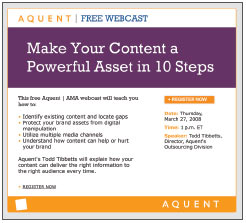
My Webcast for the American Marketing Association

TO: Macrom and Creative Contacts
SUBJECT: Aquent/AMA Webcast: Make Your Content a Powerful Asset in 10 Steps

Hi Reader:

How do you ensure that your content is a valued asset within your organization?

I thought you’d be interested in our next webcast, “Make Your Content a Powerful Asset in 10 Steps.” During the webcast, Todd Tibbetts from Aquent’s outsourcing division, Aquent Studios, will illustrate how careful planning, diligent implementation, increased collaboration, and development of success metrics and benchmarks will make your content a powerful asset that delivers the right information to the right audience every time.

Citing real examples from his clients Microsoft, Adobe, T-Mobile, Target, and Starbucks, Todd will address the following key learning objectives:

• Understand the difference between content as an asset and a liability.
• Realize opportunities for making content more powerful.
• Design and create content for maximum organizational impact.
• Learn how quality content can save money and generate more revenue.

I hope you’ll join us!

What: Aquent/AMA webcast presented by Todd Tibbetts: “Make Your Content a Powerful Asset in 10 Steps”

Who: Marketing communications managers and creative services managers who want to successfully create, leverage and manage content.
When: March 27, 2008, at 1:00 PM ET

Registration: https://amaevents.webex.com/amaevents/onstage/g.php?t=a&d=962895360&SourceId=3aquent032708
If you can't make the live broadcast but are interested in the subject, go ahead and register. We always follow up with details about the on-demand version.

Labels: , , ,

Friday, February 22, 2008

10 Steps to Make Your Content a Powerful Asset


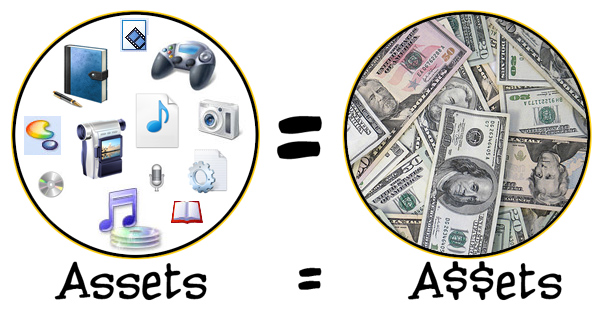
I often work with clients who are overwhelmed by their content, information and digital assets. For many individuals and companies, their content (pictures, text, video, etc) is a mess, a liability and a cost center. It takes focus and effort to turn the content from a liability into an economic asset, but the path is straight-forward and very achievable. Your organization will benefit internally and externally; creating a smother-running operation on the inside and promoting your message to the outside. You may even create additional revenue streams once you wrangle all those assets.

This is continuous publishing in a global digital media environment. Control your content before someone else does. Today much of your content is digital. And it has escaped your grasp. Below I’ll describe your ten to-do items. You’ll get control of your content and you’ll grow to understand the power and value that content will bring you.

1. Discover. Identify your existing content. What do you have? What format is it in? Perform a content inventory or content audit. Create a content matrix, a spreadsheet of all your pieces and their attributes.

2. Develop your Core. Create the essential main ingredients of your content. This is often called Single Source where a team develops base content that is used in multiple locations or formats. Crystallize your message down into the essential ingredients.

3. Prepare for Community Involvement. Your content will be captured, quoted and manipulated. Plan for it. Make your community plan. Much like a business plan, but it outlines your philosophy, approach and rules for your audience/social network. This is user-centered content creation: know your audience. Give them a voice. Give them tools like widgets or online forums.

4. Architect Your Content. Use information architecture theories and approaches. Put your content into categories that make sense. This is often called bucketing. Try doing a card sort. Your community may begin to add categories and tags to your content if you let them. This “folksonomy” approach can be powerful.

5. Create you Multi-Destinational Plan. We are in a cross-platform world. Your content will live on more than the three screens (TV, computer, mobile). Create a delivery method attribute matrix to predict where your content is most likely to land. Remember we are in the age of the globalization of content. Understand translation and localization.

6. Acquire or Build Your Tools. Content management tools will most likely be needed. Make you build vs. buy decision. Visit the CMS Matrix to get comparison information.

7. Design Your Content. Separate your content from the way it is presented. Determine the base elements of your visual brand and stick to ‘em.

8. Document it. For internal use and the retention of institutional knowledge, please document your content adventures. Develop style guides and knowledge management practices to ensure knowledge transfer to others on your team or others who may follow in the future.

9. Tell your Story Continuously. Assign, hire or rent full-time staff to constantly add new content. Generate Continuous Content. Become thought leaders. Quality content and real content wins. Don’t fill a page with keywords and call it content. Humans and machines can tell what good content is and they seek it out.

10. Track it. Define your metrics for success and document your benchmarks. Analyze your numbers. Watch them change. Modify your behavior based on results, not assumptions.

Labels: , ,